Enterprise
Advanced Analytics
Explore richer analytical views to understand performance and trends at scale.
Definition: Advanced analytics allow you to go beyond simple usage tracking to read trends, compare call populations, and drive performance more precisely.
Feature video
No video is available at this time.
| Who is this for? | Required permissions and licenses |
|---|---|
| • Managers and operations leads who oversee multiple teams. • Organizations looking for deeper insight than standard views. | • Advanced analytics are part of the Enterprise plan. • Access then depends on your data visibility scope. • Some simpler sub-views may remain visible more broadly depending on your workspace. |
How to use it
Open the analytics space
Access the analytics view available in your Leexi environment. Leexi offers 6 types of analyses: General, Topics, Scorecards, Usage, Reports, and Clusters.
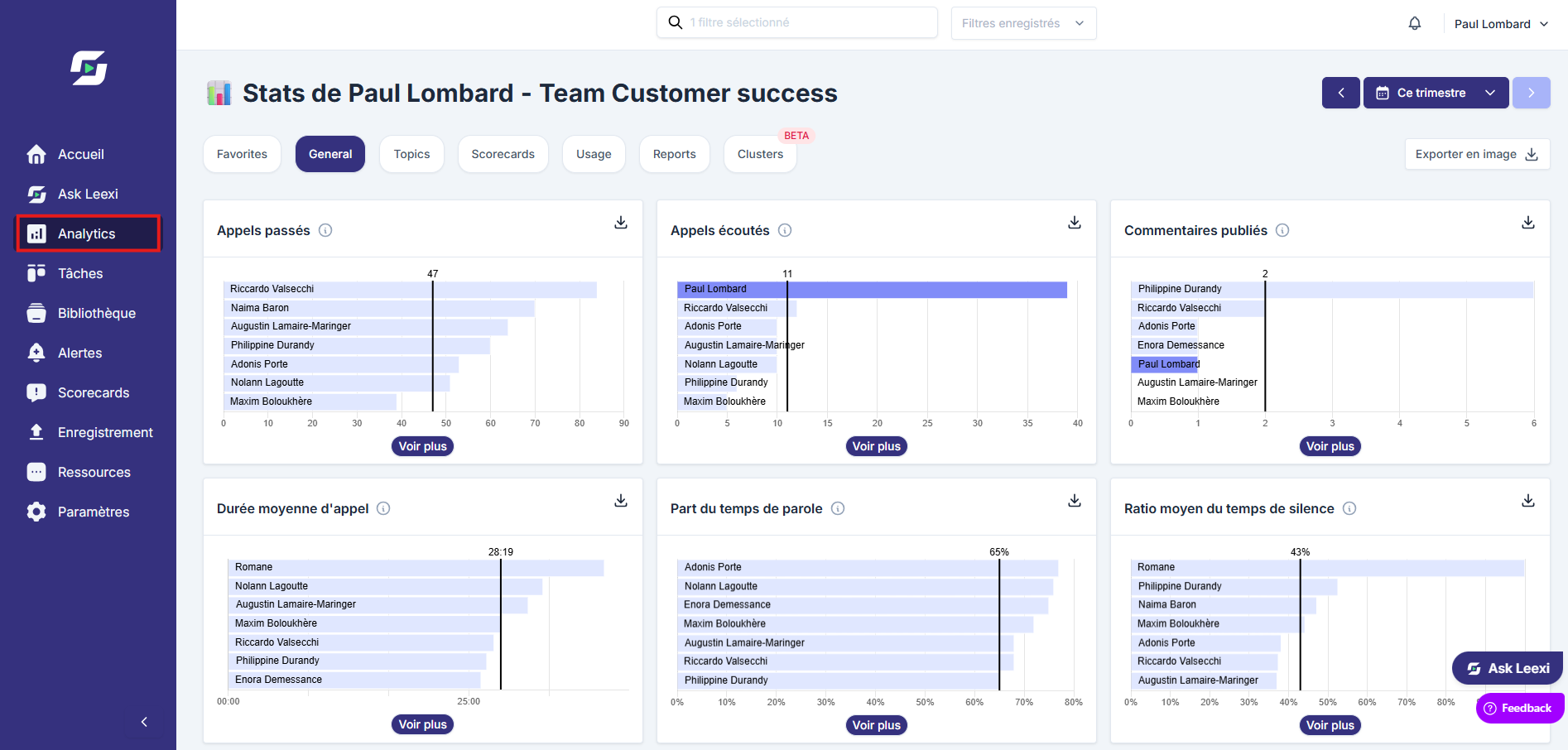
Choose the right angle of analysis
Work by period, team, topic, scorecard, or usage depending on the question you want to answer. You can filter by team, user, contact/client, tags, topics, deal status, call direction (incoming/outgoing), and many other criteria.
Filter the right scope
Refine data to avoid overly broad or misleading conclusions. You can also display calls related to a metric by clicking on the corresponding box.
Share useful analysis
Export or share useful results with your teams to guide next steps. You can return to previous periods using the navigation arrows.
Going further
- Advanced analytics help objectify trends that aren't visible at a single call level.
- They become more valuable when the library, topics, and scorecards are well-maintained.
- Good analytical framing always starts with a clear question.
- The Clusters view (BETA) lists the most frequently asked challenges, objections, and questions from clients.
- The Reports view gives access to weekly AI-generated reports for a team or person.
Frequently asked questions
No. Usage analysis mainly tracks platform adoption, while advanced analytics open a more business-focused and structured view.
Yes, depending on the export options available in your interface.
Things to watch out for
- Poorly filtered analysis can produce misleading conclusions.
- Compare equivalent scopes before drawing a conclusion.
- The cleaner your classification framework, the more reliable your analyses are.